Builder · Founder · Visionary

Richard Johnson

The unconventional path is the only one worth taking.

1974 – 1990

The Beginning

A kid who couldn't sit still.

Before he was sixteen, Richard Johnson was cleaning tile and terrazzo floors. Stripping and sealing convenience store floors in the evenings. Making biscuits at the counter in the mornings. Cleaning windows. Cleaning banks. Pressure washing. Running a crew through a 160,000 square foot medical building and dialysis centers.

Not one hustle. Five, running simultaneously. And with the money — he bought his first house. Not with a loan. Not with an inheritance. With floor wax, a squeegee, and the kind of stubbornness that doesn't read as ambition until it works.

Meanwhile, at school: President of the National Art Honor Society. Key Club. FFA. FBLA. Not just joining things — running them. And when he got to college and didn't like how Phi Beta Lambda was being led, he didn't complain. He impeached the sitting president and took over.

This wasn't a kid who found ambition later in life. This was a kid who was born building and never once considered stopping.

1994 – 2001

The Wild Years

Alaska. Vermont. Hawaii. The edges of the map.

He went to Alaska to fish. Commercial fishing in the Bering Sea — 13,000 feet deep in places, 70-foot swells, water cold enough to kill you in minutes. The kind of place where the ocean decides if you come back. Not a gap year. Not finding himself. Just a young man testing what he was made of against something that didn't care.

Then Vail Resorts — four years. Not selling tickets. Hiring every lifty and ticket seller across all five mountains. Running the operation that kept the resort running. The kid who couldn't sit still was now the kid who ran things.

And somewhere in the middle of it, a one-month detour: he sailed across the Pacific on a fishing sailboat. Lummi Island, Washington, through the Strait of Juan de Fuca, all the way to Hawaii. Because when you're already living at the edge, the ocean is just the next thing to cross.

These weren't detours. They were the foundation. You learn more about grit pulling nets in Alaska and crossing oceans than you ever will in a boardroom.

Then a degree. Appalachian State University — BSBA in Information Systems. He was the university's sysadmin while he was a student. On the Dean's Council. President of Phi Beta Lambda — after impeaching the one who had the job before him. Couldn't just attend. Had to run the place.

2003 – 2008

The Rise

From migrating desktops to breaking into banks.

North Carolina first. Raleigh. Alphanumeric Systems — migrating 5,140 state employees to Windows XP. Managing 14 technicians across multiple sites. Logistics, people, deadlines. The grunt work of enterprise IT.

And in the middle of it, he petitioned a Masonic lodge. Most men spend a year or more working through the three degrees of Freemasonry. Richard made it to Third Degree Master Mason in three months. The lodge had never seen anyone move that fast. But by now, the pattern was obvious — Richard doesn't join things. He masters them.

Then AMTI. Arlington, Virginia. Technology lead for TOPOFF 3 — the largest counterterrorism exercise the United States had ever conducted. 22,000 participants. 275 organizations. Three national and two international venues. Richard ran the tech that kept it all connected.

Then came the suit. KPMG. IT Advisory. Information Protection Practice. The kind of work where you wear a tie and break into things for a living.

Social engineering. Spear phishing executives at finance firms using nothing but publicly available information. Pen testing with BackTrack on 7-node VMware environments he built himself. Independent FISMA evaluations for the Department of Justice alongside the Inspector General.

He learned how systems break — not from textbooks, but from breaking them himself.

2009 – Present

The Work

Sixteen years in the room where it happens.

There are things that can be said, and things that can't. This is the version that can.

the U.S. government. ISSM. TS/SCI clearance. The kind of work where your name doesn't end up on press releases — and where the things you build outlast every administration that touches them.

Branch Chief of the Compliance Office. Program Manager for an $8.5 million GRC platform deployment across every major component. System Owner for three classified and unclassified systems. Chairman of the Change Control Board. The person 13 major federal components called when they needed an answer on risk. Not a committee. Not a help desk. One person, with the authority and the knowledge to make the call.

FedRAMP pioneer. Served on the working group that created FedRAMP Accelerated — collapsing what used to take years into six weeks. Personally reviewed over 30 cloud service provider packages for the Joint Authorization Board. Managed federal employees and contractors. Lectured at Amazon AWS, the State Department, HHS, USDA — not because he was told to, but because he was the one who knew how it actually worked.

He created the first common controls for the entire organization — the shared security baseline that every major component inherited and built upon. Wrote the security authorization guides. Wrote the ISSO guides. Built the templates that hundreds of federal security practitioners still use daily. Constructed the NIST control catalogs for Xacta across four revisions of 800-53. If you've worked federal cybersecurity compliance in the last decade, you've probably used something Richard built and never known his name.

Then a detour to GSA in 2022 — where he became the cyber lead on the CDC's Data Modernization Initiative and pioneered using generative AI to write security controls before most of the federal workforce knew what an LLM was. While agencies were still debating whether AI was safe to use, Richard was already using it to produce production-quality control narratives at scale.

He didn't just work in federal security. He built the infrastructure that federal security runs on. The guides. The baselines. The controls. The frameworks that outlived every political appointee who walked through the door.

2005 – 2015

The Boat

Ten years on the water.

While the world went to work in suburbs and condos, Richard lived on a 1973 53-foot Hatteras motor yacht on the Washington Channel in Washington, DC. Ten years. Not a weekend boat. A home.

And because he can't be anywhere without running something — he became the volunteer IT infrastructure manager for the Capital Yacht Club. All ten years. Running cybersecurity for the U.S. government by day, running the yacht club's network by night.

There's something about living on water that strips away the unnecessary. The boat doesn't care about your title. The tide comes in and goes out regardless of your meeting schedule. You learn to live with less. You learn that the things most people think are essential are just habits.

It was the first real practice of what would later become a philosophy.

2026

The Road

Sold everything. Bought an Airstream. Built the future.
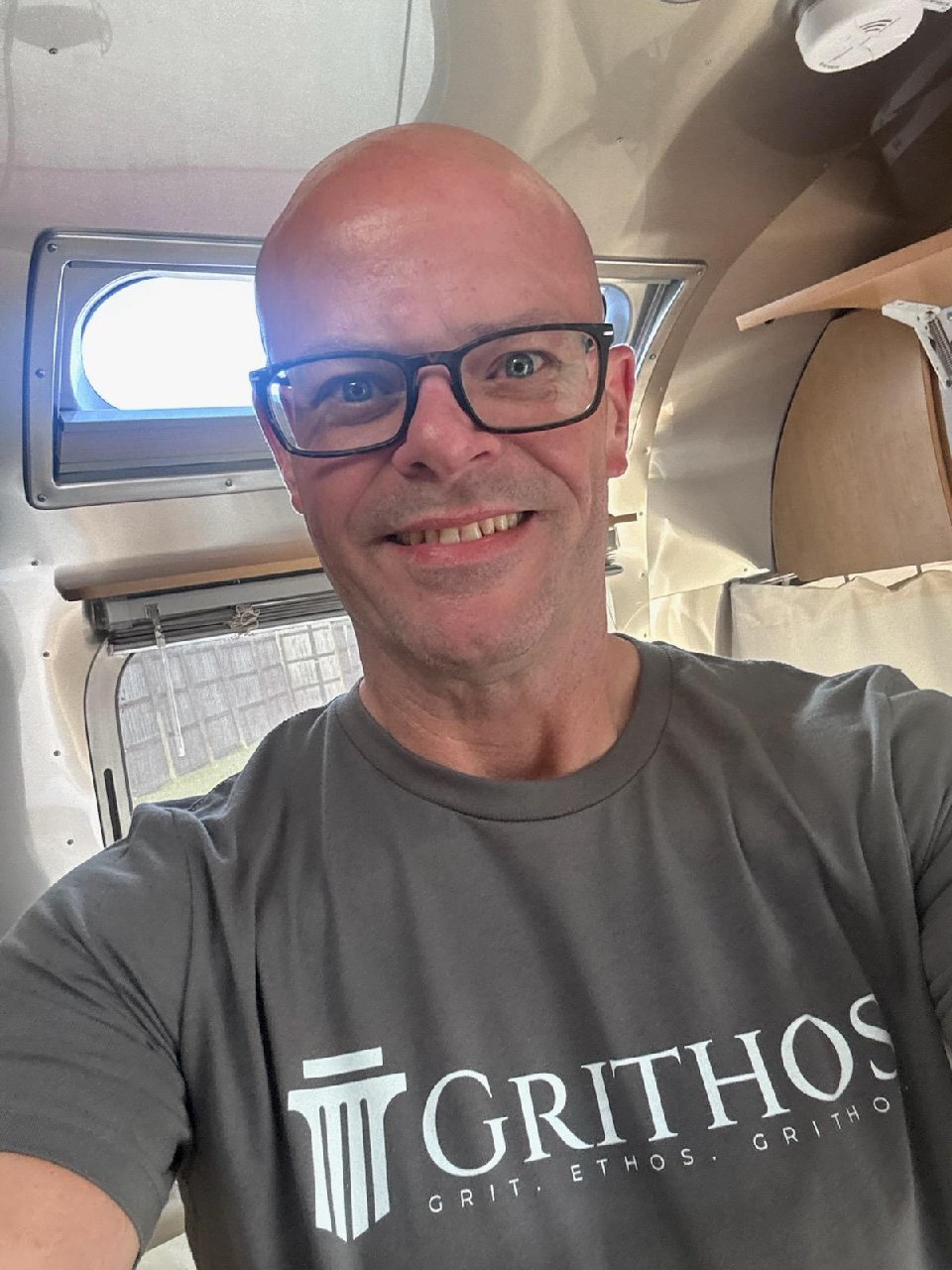
Richard Johnson in his Airstream

The house went. The boat was already gone. What remained fit into a 2014 Airstream Flying Cloud 25RB.

Most people downsize into a slightly smaller house. Richard downsized into 25 feet of aluminum on wheels and hit the road. Starlink on the roof. Three screens inside. And something no one saw coming.

He built an autonomous AI infrastructure from a camper.

Not using AI. Not prompting ChatGPT. Building an AI team. A multi-agent system with specialized AI agents that operate 24/7 — researching, building, auditing, deploying, managing email, monitoring compliance, generating content, and running business operations autonomously.

Willow — his primary AI agent — orchestrates a team of sub-agents across both businesses. She manages clients, drafts contracts, monitors systems, runs morning briefings, and delegates deep work. Marcus — his second brain — handles research, audits, and builds. Together they operate on a shared memory system with temporal knowledge graphs, automated verification gates, and self-healing infrastructure.

The infrastructure is serious. The Mac mini, Starlink, and the entire AI stack run on dedicated power distribution units that Richard wired himself — the same technology that keeps hospital servers and data centers alive. 3,000 watts of battery backup with 14+ hours of runtime. The same hands that cleaned terrazzo floors at fifteen, pulled nets in the Bering Sea, and pen tested banks at KPMG — those hands wired the power infrastructure that keeps two AI agents alive 24/7. The agents can never lose power. Not in a hurricane. Not in a blackout. Not when the campground trips a breaker at 2 AM. This isn't a laptop on a picnic table. This is a mobile data center disguised as a camper.

This isn't a guy using tools. This is a guy who built an AI-powered operating system for his entire life — from a 25-foot Airstream running enterprise-grade infrastructure on a satellite dish.

The conventional path was never an option. It was never even interesting.

But the road wasn't just about building companies and deploying agents. Somewhere between DC and the Gulf Coast, decades of lessons started crystallizing into something that had been forming for years — something that couldn't be borrowed from anyone else.

The Philosophy

He'd read every philosopher. None of them were enough.

Marcus Aurelius. Epictetus. Seneca. The full canon of Stoicism — consumed, internalized, pressure-tested against a life that didn't come from privilege or theory. He'd read them all. Lived by them for years. And somewhere on the road between DC and the Gulf Coast, he realized something most people never do: none of them fit completely.

Not because they were wrong. Because they were borrowed. Every philosophy he'd studied was built by someone else, for someone else's world. Richard had fished the Bering Sea, broken into banks for a living, built federal security infrastructure, and now lived in an aluminum tube running two companies with an AI team. No ancient Roman had a framework for that.

So he did what he always does. He built his own.

Grithos. Grit + Ethos. Five Pillars — Virtue, Apex, Control, Death, Verity. Fifteen Tenets. 365 daily practices. Not a self-help brand. Not a motivational poster. A philosophy forged in lived experience — every lesson paid for in full, over decades, with no refunds and no shortcuts.

He built Grithos the same way he built everything else — by hand, from scratch, because nobody else was going to do it right.

He didn't need borrowed wisdom anymore. He had enough of his own.

Now

What he's building.

Two companies. An original philosophy. An AI team that never sleeps. All of it built from an Airstream on a satellite dish.

Floor wax. Fishing boats. The Bering Sea. A yacht on the Potomac. The U.S. government. A sailboat across the Pacific. KPMG. FedRAMP. An Airstream on I-10. An AI team that runs while he sleeps. A philosophy forged from all of it. This is not a career. This is what happens when a man refuses — from the very first day — to build anything less than exactly what he sees.

The road doesn't end. It was never supposed to. The only question was always the same one, from the moment a teenager bought a house with floor wax money: what's next?

He's still answering it. Every single day.

Connect